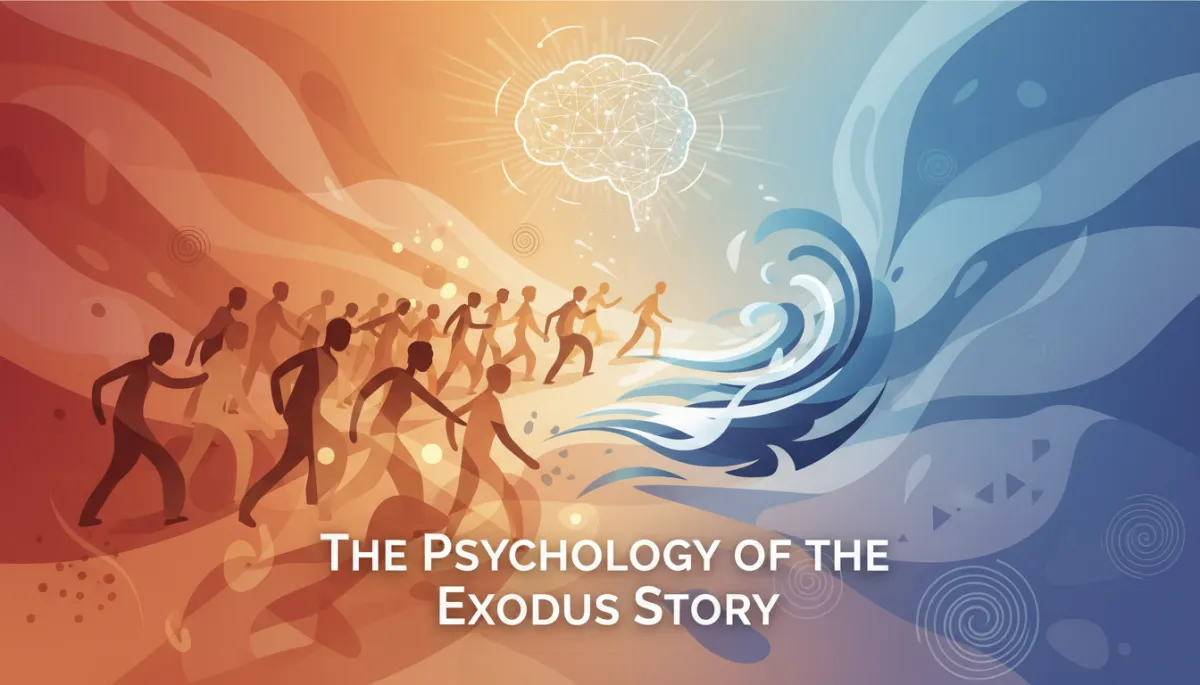
The Psychology of the Exodus Story
Psychology, Spirituality, Narrative
The Exodus Story, Creative Passion... and You
The Exodus narrative is more than an ancient religious tale; it is a powerful psychological map of how people move from bondage to freedom, fear to trust, and despair to hope—both collectively and within the inner life of every individual.
Exodus as an Inner Journey, Not Just a Historical Event
On the surface, the Exodus story is about an enslaved people leaving Egypt and travelling toward a promised land. Psychologically, it mirrors a universal inner movement: leaving a familiar but limiting life, entering an uncertain in‑between space, and slowly growing into a new identity. In this reading, Egypt can symbolize any situation where we feel trapped—by habits, relationships, beliefs, or systems that once kept us safe but now keep us small. The promised land represents a more authentic, integrated way of living that we can sense but not yet see clearly.
This is why the story resonates across cultures and centuries. It speaks to the quiet realization that “the way things are” is no longer tolerable, and to the courage required to step into the unknown. From a psychological perspective, Exodus is about transition: the difficult emotional work of leaving behind what no longer fits, before the new life has fully formed.
Slavery, Learned Helplessness, and the Fear of Change
The Israelites in Egypt are not only physically enslaved; they are psychologically conditioned to expect oppression. Modern psychology calls this learned helplessness—a state in which repeated experiences of powerlessness teach people that their actions do not matter, even when opportunities for change appear. In the story, even after witnessing dramatic signs and gaining their freedom, the people repeatedly say they want to go back to Egypt. The known misery feels safer than the unknown possibility of freedom.
This tension reflects a basic psychological truth: change is threatening, even when it is positive. The Exodus story portrays the inner conflict between the part of us that longs for liberation and the part that clings to old patterns because they are familiar. It shows how deeply fear, dependency, and habit can anchor us to circumstances we consciously say we want to escape.
The Wilderness: A Portrait of the In‑Between Self
If Egypt symbolizes bondage and the promised land symbolizes wholeness, the wilderness represents the messy middle. Psychologically, this is the stage where old identities have been stripped away, but new ones have not yet solidified. It is marked by uncertainty, testing, and emotional volatility—exactly what we see in the narrative: complaints, nostalgia, rebellion, and moments of deep trust followed by sudden doubt.
Many therapeutic journeys look like this. People leave a destructive pattern or relationship, only to find that the space afterward is not immediately peaceful. Instead, they face loneliness, anxiety, and the hard work of re‑learning how to live. The wilderness in Exodus captures this uncomfortable but necessary phase where growth often feels like loss, and progress looks suspiciously like wandering in circles.

The wilderness stage mirrors the vulnerable in‑between space of deep personal change.
Moses, Leadership, and the Burden of Guiding Change
Moses himself is a psychologically rich figure. He is reluctant, doubtful, and often overwhelmed—a far cry from the flawless hero. His journey captures the emotional cost of leadership during transformation. He carries the projections of the people: their hopes, fears, and frustrations. When they are afraid, they turn on him; when they are hopeful, they idealize him. This dynamic reflects how, in families, organizations, and societies, leaders often become screens onto which others project their inner conflicts about change.
Moses also wrestles with his own identity: raised in Pharaoh’s house yet identifying with an oppressed people, he embodies the tension between two worlds. Psychologically, he represents the part of us that hears a deeper call—an inner voice insisting that the current situation is not the final word—and yet feels inadequate to act on it. His hesitations and arguments echo the internal dialogues many people experience when they sense it is time to leave a limiting situation but feel unprepared to do so.
Miracles, Trust, and the Slow Work of Rewiring Belief
The Exodus story is filled with dramatic moments—plagues, parted seas, daily manna. Psychologically, these scenes can be read as experiences that challenge entrenched beliefs. People who have internalized powerlessness need repeated, embodied experiences that “the world can be different” and “I am not entirely alone.” In modern terms, these are corrective emotional experiences that slowly rewire our expectations about what is possible and who we can rely on.
Yet the story is honest about how fragile trust can be. Even after witnessing extraordinary events, the people quickly return to anxiety and doubt. This reflects how deeply our early experiences of safety or danger shape us. New patterns of trust do not emerge overnight; they are built slowly, through repetition, especially in the “wilderness” seasons when nothing feels certain and old fears are easily reawakened.
Why the Exodus Story Still Speaks to Our Inner Lives
The enduring power of the Exodus narrative lies in its psychological honesty. It does not romanticize liberation or pretend that freedom is a straight line. Instead, it portrays a people who are inconsistent, afraid, forgetful, hopeful, and resilient—much like us. Whether or not we read it as literal history, the story functions as a mirror: Where am I still in “Egypt”? What does my wilderness look like? Which inner voice plays the role of Moses in my life, calling me forward even when I resist?
Seen through a psychological lens, Exodus becomes a timeless guide to inner transformation. It acknowledges the cost of leaving familiar forms of bondage, the confusion of the in‑between, and the gradual formation of a freer, more grounded self. In that sense, the story is not only about a people long ago; it is about the ongoing, deeply human work of walking out of whatever enslaves us and learning, step by step, how to live as if freedom were truly possible.